Wednesday, December 27, 2023

Rachel weeping.


St. Matthew the Evangelist quotes Jeremiah the prophet while detailing the massacre of holy Infants by King Herod. "Thus says the Lord: “A voice was heard in Ramah, Lamentation and bitter weeping,

Rachel weeping for her children,

Refusing to be comforted for her children,

Because they are no more.”"(St. Matthew 2:18 and Jeremiah 31:15; NKJV). In the book of Genesis, we read about Rachel dying after she had given birth to Benjamin, and Jacob burying her on the way to Bethlehem:

"And when there was but a little distance to go to Ephrath, Rachel labored in childbirth, and she had hard labor. Now it came to pass, when she was in hard labor, that the midwife said to her, “Do not fear; you will have this son also.” And so it was, as her soul was departing (for she died), that she called his name Ben-Oni; but his father called him Benjamin. Rachel died and was buried on the way to Ephrath (that is, Bethlehem)." (Genesis 35:16-19; NKJV).

The matriarch was buried on a wayside towards Bethlehem, and the prophet Jeremiah prophesied about Rachel crying for the Israelites, as a beloved mother would cry for her children when they would be driven from their homes and forced into exile in Babylon. A lovely Jewish tradition states that when Joseph was sold by his brothers and taken by his captors to Egypt, they happened to pass by Rachel's tomb where Joseph cried bitterly. It is then he heard his mother's comforting voice assuring him that the Lord will be with him all through.

Hundreds of years after Rachel completed her earthly course, prophet Jeremiah talked of her weeping for Israelites and St. Matthew talks of the matriarch's sorrow as she witnesses the great lamentation of the Hebrew women whose little children were slaughtered by the tyrant.

Herein the Holy Scripture attest to the awareness of our departed ones regarding us. The departed patriarchs and matriarchs, holy fathers and mothers are interceding for us. Our Lord and Saviour Jesus Christ said: "For He is not the God of the dead but of the living, for all live to Him.” (St. Luke 20:38; NKJV).

In the words of prophet Jeremiah, the Lord comforts (the departed) Rachel upon hearing her cries for the Israelites:

"Thus says the Lord:

“Refrain your voice from weeping,

And your eyes from tears;

For your work shall be rewarded, says the Lord,

And they shall come back from the land of the enemy.

There is hope in your future, says the Lord,

That your children shall come back to their own border." (Jeremiah 31:16-17; NKJV).

May the prayers and intercession of the holy mother Rachel be a source of comfort and refuge to all especially for the children whose mothers have departed from earthly life, women facing complicated pregnancies and those who suffered miscarriages, and for those couples having difficulty in conceiving.

In Christ,

Rincy

Who trespassed my garden?

 Reflection on the feast commemorating the slaughter of the infants by King Herod (December 27).

"The slayers of Bethlehem mowed down the tender flowers that among them — should perish the tender seedling, wherein was hidden the Bread of life….The murderers went into a paradise, full of tender fruits:— they shook off the flowers from the bough, blossoms and buds they destroyed — unblemished oblations he offered, the persecutor unwittingly.— To him woe, but to them blessing! Bethlehem was first to give, virgin fruits to the Holy One."-St Ephraim the Syrian (Hymns on the Nativity, NPNF Vol. 13)

Flavius Josephus recounts the end days of the Herod (in Book XVII-Antiquities of the Jews) as being agonizing beyond measure. Herod’s colon gave excruciating pain, his intestines were laden with ulcers and he had an awful appetite. Some kind of secretion was noted in his feet and belly. His private parts became rotten and produced worms. His breath produced great stench and he had difficulty in breathing while sitting upright. He had also convulsions in all parts of his body: which increased his strength to an insufferable degree. The fortune tellers shared that God inflicted this punishment on the king on account of his great impiety.

While listing down the misdeeds of Herod, Josephus does not mention about massacre of the holy infants in Bethlehem that happened under the king’s directive. It may be perhaps that the incident occurred in a tiny rural area and did not get the importance of a headline news in the Roman empire. Eusebius, in Church History-Book I, mentions that the pitiable situation of Herod immediately came to pass after he ordered the killing of infants in his bid to kill the Infant Christ.

Indeed, the cries of the little children and their mothers rattled the heavens (and does so even today).

The technological era offers a plethora of opportunities to overstep the marital boundaries and the definition of what constitutes infidelity is ever expanding. A huge majority of people live this dual life. One personality is the public image- the family-oriented avatar and the other personality lies in a secret dark world- the tech avatar for their extramarital fun. This is the reality of our society that is not talked about often.

In all this mess, a child is the oft forgotten entity. Unlike what people assume, children are acutely aware when an intruder trespasses their garden of familial ties. Despite the conscience warning against the forbidden bonds, if one continues the illicit path, it implies their acceptance to hurt these innocent ones. Herod is not merely a monstrous historical personality. Herod is a reality- each one of those is a herod who knowingly hurts an innocent soul.

Our Lord warns-“Take heed that you do not despise one of these little ones, for I say to you that in heaven their angels always see the face of My Father who is in heaven.” (St Matthew 18:10)

The guardian angels of these little children are their ever-present intercessors before the Father.

If you are the ‘other woman/man’, you clearly don’t want a child to rattle the heavens against you. Can you withstand the dreadful encounter of the child’s guardian angel demanding an answer- “why did you trespass the child’s garden”?  If not, then repent.

If you have been the unfaithful spouse/parent, can you withstand the dreadful encounter of your child’s guardian angel demanding an answer- “who allowed the trespasser in this garden”? If not, then repent.

May the prayers and intercessions of the holy innocents give a childlike innocence and simplicity to the blemished souls.

In Christ,

Rincy

Tuesday, December 26, 2023

Hope for the world and us- Reflection on the feast of the Nativity of our Lord.

 Christ is born! Glorify Him!

“It was the first time that I went to a parish under the diocese of Kottayam to celebrate the Yeldo liturgy. I reached there by 2 AM. The altar assistant was very busy and said that we would start the liturgy by 3 AM. At 3 AM, the altar assistant said that we should wait a little longer since nobody had arrived. I told him, “you stay here. I am going to start the prayers.” The prayers started but still no one came.

Then, a lizard appeared and so did a cockroach. I was grieved on seeing this situation.

The Lord said: “Don’t be sad about it. When I was born, I opened My eyes to see cattle and sheep around Me”. On understanding this, my sadness withered away.”- His Grace Geevarghese Mar Ivanios Metropolitan of blessed memory.

The scene of the nativity of Christ, amidst the animals and the shepherds who tend the sheep, reminds of our primal connection with nature. “For God so loved the world that He gave His only begotten Son, that whoever believes in Him should not perish but have everlasting life. For God did not send His Son into the world to condemn the world, but that the world through Him might be saved.” (St. John 3:16,17 NKJV). Our restricted view considers Incarnation of our Lord for the cause of humans alone, however the Gospel underlines that God loved the world. Henri Nouwen writes in Bread for the Journey:

“When we think of oceans and mountains, forests and deserts, trees, plants and animals, the sun, the moon, the stars, and all the galaxies as God’s creation, waiting eagerly to be 'brought into the same glorious freedom as the children of God' (Romans 8:21), we can only stand in awe of God’s majesty and God’s all-embracing plan of salvation. It is not just we, human beings, who wait for salvation in the midst of our suffering; all of creation groans and moans with us, longing to reach its full freedom... Yes, we have to love the fields full of wheat, the snowcapped mountains, the roaring seas, the wild and tame animals, the huge redwoods, and the little daisies. Everything in creation belongs, with us, to the large family of God.”

St Isaac of Syria taught that in the presence of a humble person the ferocity of the wild beasts is tamed. It is so because the scent from the humble person is the same as which came from Adam before the Fall (the scent of humility); wherein Adam had affectionate relations with all the beasts, and he gave the names to them in Paradise. This scent was taken away from humanity and given back anew by Christ through His advent.

A story from the tradition of desert fathers and mothers goes like this- one day while abba Macarius was praying in his cave in the desert, a hyena suddenly appeared and began to lick his feet and taking him gently by the hem of his tunic, she drew him towards her own cave.  He followed her, saying, "I wonder what this animal wants me to do?" When she had led him to her cave, she went in and brought her cubs which had been born blind.

He prayed over them and returned them to the hyena with their sight healed. She in turn, by way of thanks-offering, brought a huge skin of a ram and laid it at Abba Macarius’s feet. He smiled at her kindly, took the skin and spread it under his feet.

If we slow down enough to notice the expression on the face of infants, we will see that they look at their surroundings with a sense of amazement. As we grew, we ignored the sense of sacredness and awe in comprehending the world around us that quietly and continually preached the glory of God.

The Nativity of our Lord coming at the end of the yearly journey is a milestone to renew hope for the onward voyage. The commercial dynamics teach us the more we spend, the better we have celebrated Christmas. Our Christmases have become merrier in a worldly sense, but we have forgotten to share the flame of hope that the birth of our Lord proclaims. Five years back, enroute on our visit to the Church of the Nativity in Bethlehem we were given a general advice that those with infants/toddlers need not stand in the long queue to the Altar of Nativity (an underground space which marks the spot where Jesus was born) and could directly go to this Altar by means of another route. As we reached the church there were a multitude of pilgrims and we somehow couldn’t get in touch with the tour personnel to get information on this alternative route. With a year-old baby in arms, who would get cranky easily in a crowd, I had almost made up my mind that the baby and I would miss the Nativity Altar. Suddenly, a tour guide from another group- a considerate cheerful old man with a black and white keffiyeh around his neck asked if we were Orthodox (and he was too). He said that we need not wait in the queue and gave us clear instructions on how to proceed to the Altar of Nativity. We went to the holy place with hearts full of gratitude and the baby kissed the place where our Lord was born. A silent miracle witnessed.

In the elderly man, we saw the shepherds ‘who made widely known the things concerning Baby Jesus (St. Luke 2:17). In the midst of tiredness and dejection, as we heard this elderly man’s guidance, we felt how Jesus Christ wants the little children to come to Him (St. Luke 18) even to the cave where He was born.  

The shepherds- common everyday folks- shared the Gospel with others serving as a model for us to be the quotidian harbingers of hope to others once the celebrations and noise are over. A translated excerpt from  Kaikkudnna (by ‘Saker’- His Grace Zechariah Mar Severios Metropolitan, Baselian Books) is as follows:

“It is saddening to see that our dealings and interactions with others hardly fail to generate a sense of optimism and faith in others. It is frightening to think about how many days in our lifetime have passed, without us, having presented hope and courage to those whom we met. When will the time come, when our visitation to our neighbour’s home offers him comfort? How much more time is needed for our words to become a source of hope and relief to our colleague? We need to think if we are indeed becoming blessings for our homes.

In a poem, a tree asks a man: “For so many years, you all have cut my branches to make ‘crosses’. But why don’t we see a Christ amongst you?””

In Christ,

Rincy


Saturday, December 16, 2023

Our oblivion of the sacred silence.

Reflection on the holy Gospel reading (St. Matthew 1:18-25)- Revelation to St. Joseph the just.

The crux of Christmas and thereby the story of salvation of mankind can be summed up as the humility and love of God for man that made Him willingly endure Cross and trample death. In communities with a deep foundation of patriarchal values, machismo is the norm while the godly virtues of humility and silence is considered highly incongruous for the man of the house. In this backdrop we remember the angelic command to an ordinary carpenter-St. Joseph the just, an epitome of silence of humility who faithfully and silently ministered his betrothed Blessed Virgin and her Child.

In my limited knowledge, only two parishes in India under the Malankara Orthodox Church are named after St. Joseph the just (one in Tughlakabad, New Delhi and the other in Bangalore).

Why is our tradition strangely silent in commemorating the feast of the foster father of our Lord? Why have we allowed his memory to fade? 

 - Is it because St. Joseph’s mission of servant leadership in domestic life upends the societal privileges of men in a family set-up? The renowned poet from Kerala, K Satchidanandan writes- “To love a woman is to exchange the harshness of your muscles for the tenderness of a flower.” (While I Write; Harper Collins). To follow St Joseph’s mission in family life is to execute the great burden that society has traditionally thrust upon women- to silently continue work amidst sufferings and to be content with a second place in home and life.  

 - Is it because the role of St. Joseph as the helper (of the Blessed Virgin and her Child) will trigger the combustible egos of the patriarchal society that fosters a skewed concept of family dynamics wherein the commitment to marital duties falls chiefly on the woman?

 - Is it because on such feast day(s) the sermons on St. Joseph’s silent relentless service to his betrothed Blessed Virgin and her Child will prick the societal conscience as it will serve as an yearly reminder to the menfolk of their duty to selflessly serve their home/community? 

 “Then Joseph her husband, being a just man, and not wanting to make her a public example, was minded to put her away secretly. But while he thought about these things, behold, an angel of the Lord appeared to him in a dream, saying, “Joseph, son of David, do not be afraid to take to you Mary your wife, for that which is conceived in her is of the Holy Spirit.” (St. Matthew 1:19-20; NKJV).

Seen from the conventional lens of the society this verse is understood to praise St. Joseph’s magnanimity in not divorcing the holy Theotokos for her alleged unchastity. However, seen from the spiritual lens of St. Joseph, it is an act stemming from his humility. How is St. Joseph’s intent to separate from St. Mary considered just and an act of humility?

In the Old Testament narrative regarding the birth of Samson we note that Manoah doubted his wife's story about an angelic visit promising them parenthood. The Angel of the Lord gives a patient hearing when Manoah probes further (ref: Judges 13, NKJV).

The betrothed Virgin tells Angel Gabriel during the annunciation - “How can this be, since I do not know a man?” This very statement of St. Mary shows her resolve to lead a celibate life. It is improbable that St. Joseph would be unaware of the Blessed Virgin’s determination and her spiritual depth. If St. Joseph doubted the Virgin’s chastity, he too could have asked for proof like Manoah did - praying for a second angelic visitation in his presence. If God was so patient with Manoah's questions, surely He would have heeded to the righteous man’s request to alleviate doubts on the Virgin Birth.

On a closer scrutiny of the verses, we note that unlike the various angelic visitations in the New Testaments, wherein the angels reassure the listeners to not be afraid of their presence, St. Joseph is instead asked not to fear in taking St. Mary as his wife.

"When Simon Peter saw it, he fell down at Jesus’ knees, saying, “Depart from me, for I am a sinful man, O Lord!” (St. Luke 5:8; NKJV). This passage tells the incident about Jesus calling the four fishermen as disciples and the miracle of catching a multitude of fishes. After the miraculous catch of the fish, Simon Peter becomes aware that he has encountered holy, and he asks Jesus to go away because he sees himself as unworthy to stand close to Him.

As a devout Jew, St. Joseph would be aware of the prophecies of Isaiah regarding the Virgin birth of the Lord. Those great frightening events prophesied ages ago were now unfolding right before his eyes. Like Simon Peter requesting the Lord to depart from Him being aware of his own unworthiness, the righteous St. Joseph considers himself extremely unworthy for the great calling. He is overwhelmed with the great fear of the holy- the great fear of being in the same dwelling as the Lord and His mother and it is this holy fear of his that the angel comforts. 

Origen says: "But if he had no suspicion of her, how could he be a just man, and yet seek to put her away, being immaculate? He sought to put her away, because he saw in her a great sacrament, to approach which he thought himself unworthy." (Catena; Thomas Aquinas)

St. Joseph’s dilemma with a pregnant Virgin can be contemplated in the first four beatitudes [St. Matthew 5:3-10] - a broken (poor in spirit-v.3) and grieving (mourn-v.4) man who mourns in silence (meek-v.5) longing to do what is right (hunger and thirst for righteousness- v.6]. Jesus calls such a man blessed.

In the next four beatitudes the virtues of St. Joseph can be contemplated upon. While going through upheavals for sake of our Lord (mockery for being with a young pregnant Virgin, displacement, massacre, exile etc.), in little what the Scripture says about him, we can sense that St. Joseph is merciful (v.7) towards the needs of his family, his conduct is pure (v.8), and he tries his best to give a life of peace to the Theotokos and her Child (v.9). The beatitudes end with a promise of the kingdom of heaven to those who are persecuted for righteousness’s sake (v.10). St. Joseph led a life of great struggle in silence and indeed, he was blessed to receive the taste of heaven- to depart the earthly life in the arms of his Lord and His mother.

How many men engrossed in the travails and temptations of the world can afford to look at their family mercifully, lead a life of purity for their children to emulate and ensure peace in their home? If ever a day is set apart commemorating his feast of St. Joseph the just, then such day should be dedicated as the Father's Day of the church. Such a day ought to serve as a great reminder for the fathers (whether spiritual or biological) to follow St. Joseph's footsteps, and to seek his intercessions so that they faithfully and selflessly conduct their stewardship duties towards home and the church. 

By the prayers and intercessions of St. Joseph the Just, may the Lord strengthen us to follow our calling faithfully and may He be pleased to dwell in our unworthy hearts and homes.

In Christ,

Rincy

Tuesday, September 15, 2020

‘Satyamev Jayate’ (Truth alone triumphs).

Life and times of Blessed Alvares Mar Julius Metropolitan (of blessed memory). Commemorated on 23rd September.


In the early hours of 14 September 1895, around 298 Maratha sepoys of the Portuguese Indian army broke open the door of the ammunitions store at the Panjim police headquarters, gathered the arms and ammunitions and with the Maratha war cry of ‘Har Har Mahadev’, rose up in rebellion. This was the second mutiny witnessed in the Portuguese Indian army after the great mutiny of 1857 that jolted their next-door colonial neighbor in the Indian subcontinent- the British.

Blessed Alvares Thirumeni’s name was in focus as being the instigator of the mutiny alongwith fellow Goan - Mr. Ignacio Caetano de Carvalho, the Viscount of Bardez.

Mozambique was another colony of Portugal and the services of the Marathas from Goa, whose fighting spirit the Portuguese were appreciative of, was called to crush the revolt in Africa. The highhanded decree, pitiable working conditions, low wages, no guarantee of the period of stay in Africa or maintenance of their families while they were away led to a high discontentment among the soldiers. The final blow was when the soldiers were threatened to be sent to Mozambique by force and subjected to physical violence. A fertile cause for mutiny. Later, the mutineers were joined by the Ranes and the revolt became so explosive that a military expedition under the command of a royal family member had to come from Portugal.

The allegations against Blessed Alvares Thirumeni was levelled by Captain Gomes da Costa, the Administrator of Ilhas, who claimed that Bishop Alvares and Viscount of Bardez were instigating the masses and the soldiers to unite and fight for the cause “India for the Indians”. Bishop Alvares had nothing to do with the revolt save for the fact that him pleaded for the cause of Maratha Sepoys in his periodicals and thus the establishment’s needle of suspicion focused on him.

Another reason why Bishop Alvares was suspected is because that newspapers in Lisbon attributed the mutiny chiefly to Lt. Col, Julio Luis Felner, the commander of the battalion who was greatly respected by the sepoys for he treated them fairly. Interestingly, Lt. Col. Felner, was also accused of lending a voice in the defense of Blessed Alvares Thirumeni when Thirumeni was tried by the Portuguese government for ‘inciting seditious’ sentiments through his newspaper, ‘O Brado Indiano’. Lt. Col. Felner’s visiting card had been found in the possession of Bishop Alvares leading to speculation that both worked hand in gloves in inciting the mutiny. What followed was a ruthless attempt by the government to crush any ‘anti-national’ voice. A war council was established filling the jails all those who were suspected to be associated with Ranes revolt/mutiny. Alvares Thirumeni's periodicals were banned and his press burnt. Thus, Alvares Thirumeni was forced to flee from his home state.

This wasn’t the first time Blessed Alvares Thirumeni suffered for siding with the truth and certainly it wasn’t the last.

As a Roman catholic priest, Padre Alvares took up the editorship of the journal, ‘A Cruz’, a religious journal dedicated to the defense of the religious and social interests of the country that appeared in 1876,  after the untimely death of its editor Fr. Manuel Agostinho de Carvalho due to tuberculosis. The young Padre exposed fearlessly, in each journal issue, the excesses and the shortcomings of the Portuguese government. The situation started to worsen with the coming of the new Archbishop- Dom Sebastião António Valente, who also became the first Patriarch of the East Indies when Goan archdiocese was elevated to the position of the Patriarchate of the East Indies in 1886. Within two months of his arrival, the Archbishop issued a decree banned ‘A Cruz’ calling it scandalous and revolutionary, forbidding the faithful from reading it. Padre Alvares wasn’t going to take it lying down and appealed to the Crown. The Goa High Court gave a ruling in Padre Alvares’ favour. Satyamev Jayate.

The was a blow to Archbishop Valente, and he used his might to file an appeal in the Supreme Court which refused to take cognizance of his petition.

Padre Alvares was forced to start another ‘A Verdade’ (meaning truth) since ‘A Cruz’ lost its readership due to the Archbishop’s orders. He also started other periodicals as well- ‘O Progresso de Goa’ and ‘Times of Goa’. Archbishop Valente became the chairman of the governing council in 1885 and Padre Alvares decided to quit Goa owing to harassment by Archbishop Valente who now exercised both ecclesiastical as well as civil powers. The following years saw Padre Alvares accepting the Orthodox faith and discharging his ecclesiastical duties as being ordained to the Episcopate as the Metropolitan of Goa, Ceylon and India (outside Malabar).

Blessed Alvares Thirumeni continued his journalistic duties to expose the corruptions and shortcomings of the government. In the July 1895 issue of 'O Brado Indiano', a riddle was published wherein the readers had to guess the name of the army officer who did a series of offences while stationed at different places. This provoked Capt. Gomes da Costa as he felt the references were attributed to him. Capt. Gomes da Costa not only took the matter to court but also demanded that a clear explanation be made in the journal's next issue as to whether the riddle was targeted at him.

Blessed Alvares Thirumeni gave a sharp-witted response in the next edition; he stated of all the people, only Captain Gomes da Costa demanded for such a clarification and that only he (Captain da Costa) can throw some light regarding his demand. Capt. Gomes da Costa was in a spot!

The matter ended in court when the respondents explained that it's just a riddle and will remain so unless the reader comes with a solution.

Vengeful Captain Gomes da Costa plotted a revenge against the venerable bishop. On 19th August, at 7 PM, Blessed Alvares Thirumeni was returning in a horse driven car from Santa Cruz when few policemen arrested him near the Phoenix fountain. On the way, the policemen forcefully tried to snatch Thirumeni's pectoral cross and ring, to which Thirumeni offered stiff resistance and said that they could remove those only after he was dead. But the violence used against Thirumeni was so great that he was forcibly deprived of the Episcopal signia. The policemen didn't stop there. They stripped the venerable bishop of his ecclesiastical vestments and paraded him to the police station in his undergarments. Alvares Thirumeni was kept in a small filthy cell measuring 3 metres long and 1.5 metres wide smelling of urine and faeces without light, air, or even a chair. 

Cases of apostasy, offences against Portugal's religion, including undue wearing of clerical vestments (a 'crime' Alvares Thirumeni was convicted and cleared of in 1890). Bishop Alvares was honorably acquitted by court on reviewing the documentary evidences. Satyamev Jayate.

Capt Gomes da Costa's vengeance wasn't satiated. He had Alvares Thirumeni arrested two days later citing treason and being a security threat both internally and externally. A leading lawyer Mr. F.X. Sales de Andrade offered security of Rs 5000 (a princely sum in those times!) for Alvares Thirumeni's bail which the judge accepted. The public prosecutor claimed that the offence was non-bailable and submitted an appeal in the High Court. Truth triumphed again as the High Court upheld the ruling of the lower court. Satyamev Jayate.

Facing innumerable persecution from the Portuguese civil and clerical authorities, Blessed Alvares Thirumeni accepted British citizenship (being a subject of British India) in 1904 and had shifted his residence, for a considerable time to Castle Rock (present day Karnataka).

In 1906, Alvares Thirumeni visited Goa and this time too, the Portuguese authorities illegally detained him. The ordeal lasted more than 30 hours. The authorities had the blessings of Archbishop Valente- the Patriarch of East Indies (the same Archbishop who we read earlier as having banned 'A Cruz') to take such action. That Alvares Thirumeni was a British subject or that he was an old man  was all thrown to the winds. The vengeance of the authorities knew no bounds. The British Consul in Goa had to intervene to release Thirumeni.

We can't even fathom the extent of harassment and dangers which Alvares Thirumeni had to undergo for speaking the truth and choosing the Orthodox faith. Even in his deathbed, there were attempts to make him renounce the Orthodox faith.

It is worth mentioning that the same Portuguese government authorities which had accused Thirumeni of being a traitor had sent distinguished representatives to stand in the first row of the funeral procession of Blessed Alvares Thirumeni. In the annals of history, the names of oppressors are forgotten but names of brave souls like Blessed Alvares Thirumeni, who fought for truth and justice till the last breath, are etched for eternity. Truth can never be hidden forever. Satyamev Jayate.

May the memory of Blessed Alvares Thirumeni be eternal! 

In Christ,

Rincy John


References: 

Carmo Azevedo; Patriot and Saint- The Life Story of Bishop Mar Julius –I, Panjim 1988

Edavaka Pathrika, 1906- Kumbham.

George Kurian, Saint Alvares Mar Julius (A life history), St Mary’s Orthodox Church, Ribander, Goa, Pgs-141-146 (includes photographs).

Pratima Kamat, Mutiny in the Portuguese Army, Farar Far, Local resistance to colonial hegemony in Goa-1510-1912, Institute Menezes Braganza, Panaji, Goa.


Saturday, September 12, 2020

The Treasure

Life and times of Blessed Alvares Mar Julius Metropolitan (of blessed memory). Commemorated on 23rd September.


Friday, October 05, 1979. A feeling of excitement and anticipation prevailed over a small group of people assembled at St Inez church situated in the Santa Inez part of Panjim. An uncommon sentiment since the sight of a graveyard usually evokes the emotion of sorrow, prayer, remembrance of the dear departed and of course, fear and dread in many.

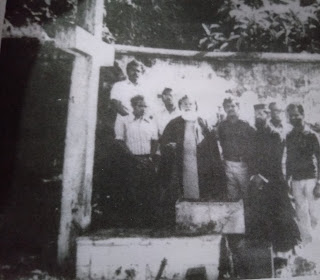
At around 3 PM that day, His Grace Dr. Philipose Mar Theophilus Metropolitan (Bombay and Angamaly diocese), Mr. Francis Alleluia Menezes (Panjim Municipal Council Chairman), Rev Fr. T.E. Isaac (Vicar- St Mary’s Orthodox Church, Panjim) along with the managing committee members of the parish were present at the St Inez Cemetery beholding a cross that stood tall amongst the wild bushes and plants which had engulfed its surroundings. That cross indeed was a simulacrum of the blessed soul, buried underneath eons ago, who withstood his ground against the ruling establishment and the Roman religious authorities even as he faced severe persecution.

The wild vegetation was cleaned with the help of cemetery workers. The onlookers bowed their heads to the tomb over which was a marble slab that stated, ‘Padre Alvares, who was a great humanitarian missionary and a great patriot.

“Offer incense before opening the grave. Gather any bone fragments found therein. If there are none, then collect the topmost portion of the soil just beneath the grave, bring it to the church and entomb it in there with grandeur.” Such were the instructions from His Holiness Baselios Marthoma Mathews I Bava Thirumeni.

Theophilus Thirumeni offered incense and prayed at the grave. The cemetery workers removed the marble slab. The sound of the church bell resonated in the premises (another burial was shortly to happen in the cemetery and a large gathering was present). It appeared a thrilling discovery was about to be made. Everyone was anxiously waiting.

The journey to this stage was a long one. There was no Orthodox Church in Panjim during the period following the Goan liberation. As the time passed, Holy Qurbana used to be celebrated in the military camps at Margao and Bambolim as and when a priest was available. Thereafter, Rev Fr. Philip Pallichira would come from Mangalore once in a month and celebrate the Divine Liturgy. This proceeded on a regular basis and thus a congregation of Orthodox faithful was formed in Goa.

In 1967, His Grace Mathews Mar Athanasios Metropolitan (Outside Kerala Diocese) (later His Holiness Baselios Marthoma Mathews I Catholicose of the East and Malankara Metropolitan) visited Goa and celebrated Holy Qurbana at St Inez Church (St Inez Church had opened its doors for the Orthodox Christians to use the church for Divine Liturgy). Thirumeni was aware that Alvares Thirumeni spent his last days in Goa and was buried there. 

After the Holy Qurbana, while having a casual chat with the vicar of St Inez Church, Thirumeni inquired about Bishop Alvares. The vicar- Rev Fr Joaquim Augesto Dias knew about Blessed Alvares Thirumeni and the exact place where he was buried. The bushes were cleared and the tomb of Blessed Alvares Thirumeni was identified. On the same day, a meeting of the Malankara Orthodox Christians was held, and it was decided that an Orthodox Church should grace Goa and the relics of Blessed Alvares Thirumeni should be translocated into this church. The realization of this dream took another 12 years. On the occasion of the golden jubilee commemoration of Alvares Thirumeni- 23 September 1973, the foundation stone of the Orthodox church in Panjim (Ribander) was laid. It was a daunting task for this small congregation to build a church, financial issues being an important concern. 

Coming back to the events of October 05, 1979. When cement and soil was removed from the grave, a lead box became visible which was taken outside with due devotion.

With trembling hands, the cover of the box was removed. The bones of the venerable bishop, whose body became one with the earth fifty-six years back, was intact and well preserved! It was indeed a glorious witness to his blessed life.

“Achen and I are taking this. You all can come after the tomb has been organized properly”, Theophilus Thirumeni’s voice choked as he said. Theophilus Thirumeni and Isaac Achen proceeded to St Mary’s Orthodox Church, with such joy and enthusiasm as if they had secured a treasure. A treasure it indeed was!

His Grace Dr. Philipose Mar Theophilus Metropolitan (of blessed memory) at St Inez cemetery when the relics of Blessed Alvares Thirumeni were taken.


The box was brought to Ribander church with piety and respect. The lead box was covered with a black covering and a sign of cross was made over it with a white cloth. Amidst candles and cross, the relics were kept for public viewing. Two days later, on October 07th Sunday, after the Holy Qurbana, the remains of Blessed Alvares Thirumeni were entombed in St. Mary’s Orthodox Church, Ribander, Panjim.

During the public meeting which happened after the services got over, Theophilus Thirumeni said that this tomb/church will become a pilgrim center not just for Bombay diocese (St. Mary’s Orthodox church, Ribander now comes under the diocese of Brahmavar) but of the entire Malankara Orthodox Church. Those prophetic words were fulfilled thirty years later in the year 2008. Panjim Municipal Mayor expressed happiness that, with the veneration accorded to Blessed Alvares Thirumeni that day, the decision taken by the Panjim municipality in 1923 was fulfilled to a certain extent (in 1923, the Panjim Municipal council had decided to erect a memorial in remembrance of the great Goan freedom fighter- Alvares Thirumeni which was refused by the Portuguese government).

When the church was reconstructed in the same place, Blessed Alvares Thirumeni’s relics were moved to the present mausoleum made on the side of the altar by His Holiness Baselios Marthoma Mathews II, Catholicose of the East and Malankara Metropolitan, in the year 2001.

St. John Chrysostom extols Antioch which received he relics of St Ignatius Noorono (who was martyred in Rome) thus: “For that city (Rome) received his blood as it dropped, but you (Antioch) were honoured with his remains, you enjoyed his episcopate, they enjoyed his martyrdom. They saw him in conflict, and victorious, and crowned, but you have him continually. For a little time, God removed him from you, and with greater glory granted him again to you.” (Homily on St. Ignatius, NPNF, Series-I, Volume IX)

The oppressors thought they had erased the memory of Blessed Alvares Thirumeni forever, but truth triumphed, and the treasure was revealed. With greater glory, God granted back to the children of the Malankara Orthodox church the venerable holy father who continuously intercedes for his spiritual children and whose life is a mighty inspiration for generations to come.

By the prayers of our holy father among the saints-Blessed Alvares Thirumeni, Lord have mercy upon us!

In Christ,

Rincy John


References:

1) (Abridged; Translated from Malayalam): Rev Fr. T.E Isaac, The Great humanitarian missionary and a patriot, Malankara Sabha, September 2001, Pg-6,7.

2) George Kurian, Saint Alvares Mar Julius (A life history), St Mary’s Orthodox Church, Ribander, Goa, Pgs-141-146 (includes photographs).

Wednesday, August 5, 2020

06th August- Commemorating His Grace Alexios Mar Theodosius Metropolitan (of blessed memory).

His Grace Alexios Mar Theodosius Metropolitan

As we celebrate the Feast of Transfiguration of our Lord, the Malankara Orthodox Church also commemorates the holy father- His Grace Alexios Mar Theodosius Metropolitan, the champion of Orthodoxy, who like the apostle(s)- St John, epitomized purity of heart; like St Peter, was zealous in his convictions; and like St James exemplified moral courage.


One of the common sayings of Mar Theodosius Thirumeni was-
“Only a converted man can convert another man; Only a converted church can convert the world”. *

The great Feast of Transfiguration commemorates the event of Christ’s appearance becoming glorious and radiant as He prayed at Mount Tabor with His disciples Peter, James, and John. There appeared Elijah and Moses, speaking with Jesus and the disciples heard a voice from the cloud- “This is My beloved Son. Hear Him!” After this awe-inspiring event, Jesus Christ and His disciples come down from the mountain and continued with healing ministry. In this context, the saying of Mar Theodosius Thirumeni is of great importance and learning. To be converted simply doesn’t mean updating the ‘religion’ section in the govt forms/IDs. The calling to the summit of the mountain is not merely to acknowledge Christ’s presence. The conversion, more than a literal physical meaning, implies the transformation of our hearts to be receptive to Christ’s Love and to share that love with others at the foothill.

BIRTH/EARLY LIFE

Mar Theodosius was born on August 28, 1888 as Chandy/M.M. Alexander in the traditionally priestly family of Mattackal at Niranam to parents Mathai and Kunjadamma. He had his school education at Mar Gregorios Memorial High School, Tiruvalla and Mar Dionysius High School, Kottayam and College education (1912-15) in the Church Missionary Society College at Kottayam.
At the age of 19, the young Alexander was called to serve in the Lord’s vineyard and received diaconate ordination from His Beatitude Joseph Mar Dionysius V (Pulikkotil II) Thirumeni. Dn Alexander joined Barisol Divinity College in East Bengal in 1915 and later in 1918 Serampore, for theological studies. In 1918, Dn. Alexander was ordained a priest by His Grace Yuyakim Mar Ivanios Metropolitan at Parumala Seminary and was called Fr. Alexios.

MEETING FR. P. T. GEEVARGHESE

It was in Serampore, that Fr. Alexios came in contact with Fr. P. T. Geevarghese (later Mar Ivanios of Syro-Malankara faction). Their focus was on starting a monastic movement which was well received among the Church dignitaries. On their return from Serampore in 1918. they established a unique monastery named Bethany and a monastic order at Mundanmala, a hilly forest area at Perunadu near Ranny on a hundred-acre plot donated by E.J. John.

Over the years, Bethany Monastery grew in stature but received a catastrophic blow when Fr. P. T. Geevarghese, its Superior, defected to the Roman faith taking with him a number of inmates on September 20,1930. It seemed that everything which Bethany stood for was lost. Fr Alexios rising up to the occasion like a flaming tower, gave Bethany a new life and led it from success to success. Today, Bethany has a complex of institutions- monastery, convent, schools and hospitals.

METROPOLITAN

Fr. Alexios was raised to the office of Episcopate on April 7, 1938 by His Holiness Baselios Geevarghese II Bava Thirumeni at Carmel Dayara, Mulanthuruthy, and took the name Mar Theodosius. Diocese of Kollam and the Outside Kerala Diocese were assigned to the Metropolitan’s charge. Mar Theodosius had the foresight and vision of the future development possibilities of the Church beyond the frontiers of Kerala. In fact, Mar Theodosios Thirumeni was the architect of the Outside Kerala Diocese. In 1947, a nucleus of the Diocese was laid when the Metropolitan formed the Indian Orthodox Mission at Madras. This was followed by organising a group of four dedicated priests viz Fr. K. A. George, Fr. C.V. John, Fr. Simon Mathews and Fr. K.C. Thomas (later His Grace Thomas Mar Makarios Metropolitan of blessed memory), who were sent to Pune, Calcutta, Coonnor and Delhi respectively. 

INTERNATIONAL FORUMS

Mar Theodosius Thirumeni took keen interest in representing the Malankara Orthodox Church in international inter-church forums and focus the attention of Western Churches to the ancient apostolic origin of Malankara Church. He travelled to London in 1933 to attend the Centenary Celebrations of Oxford Movement, to Oxford in 1937 to represent the Malankara Orthodox Church in the first Faith and Order Conference and to Edinburgh the same year to attend the Life and Work Conference, and in 1948 to Amsterdam to participate in the World Council of Churches (WCC) Conference along with His Holiness Baselios Geevarghese II Bava Thirumeni. Till 1953, Mar Theodosius Thirumeni was a member of the Central Committee of WCC.

The ardent stress on conviction of faith and on the autocephalous nature of Malankara Orthodox Church was a distinguishing trait in Mar Theodosius Thirumeni. He stood firm in his mother church even when his overwhelming mentor- Fr. P. T. Geevarghese (Mar Ivanios) left the mother church. He is quoted to have said “Even if it happens that I become the old lay man Chandy, I do not like to be a Metropolitan of a Church which has lost its freedom.”

HEAVENLY ABODE

On August 6, 1965, after battling prolonged illness, coinciding the day when the Church celebrates the Feast of Transfiguration, this great luminary of the Malankara Orthodox Church left for heavenly abode.

Mar Theodosius Thirumeni was an austere ascetic and a good shepherd who led a simple life devoted to prayer and worship. His simplicity, asceticism, conviction of faith, love, care and concern have inspired many.

May the prayers and intercessions of the holy father be our refuge always.

In Christ,
Rincy John

Ref: David Daniel, The Orthodox Church of India (History), © 1986, Published by Rachel David, New Delhi, Pgs 530-534.
*Quote of Theodosius Thirumeni referred from Bethany Asramam website-http://bethanyasramam.com/inspirers.php (accessed 05 August 2020)